With its focus on community initiatives and subaltern perspectives, CCEHR promotes interdisciplinary, transnational and comparative perspectives on cultural heritage. The Centre approaches culture in its restrictive sense as the arts and popular culture, as well as in its more anthropological sense as a way of life, with its associated artefacts, objects, symbols and rituals, representing the collective labour of people and institutions. Cultural heritage is a dynamic and contested domain: it provides a means of soft power that serves the interests of dominant or majority social groupings. At the same time, it is a potential source of cultural capital that enables communities in a post-colonial nations to conserve the legacy of physical artefacts, monuments and art forms; and the intangible heritage of cultural practices, knowledge, traditions, languages and stories, lok virsa. Researchers at CCEHR are researching, identifying and protecting the cultural heritage of Pakistan to understand and (re)evaluate the past. We are envisaging alternative futures. These efforts are increasingly significant in the context of economic uncertainty, political instability, and the growing impacts of climate change.
The Built Heritage of Sukkur
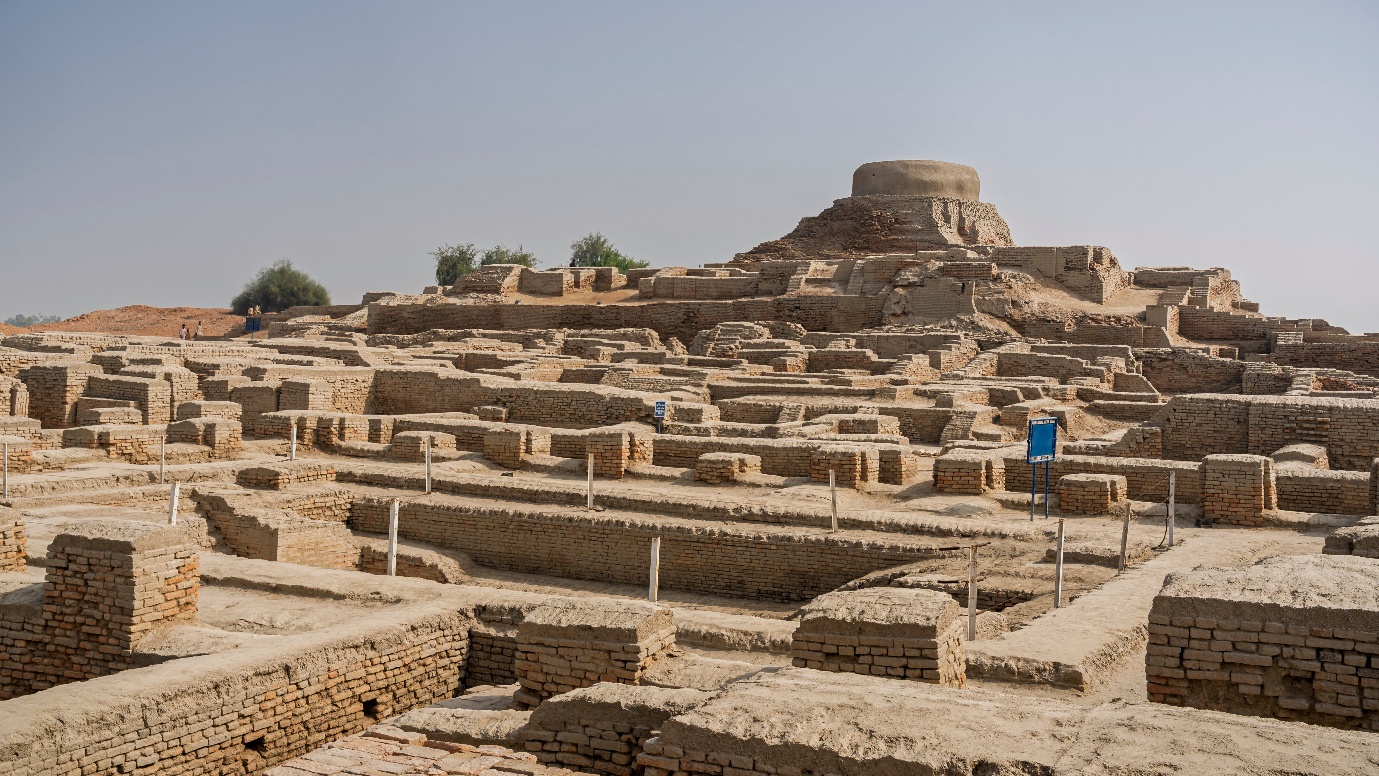
Mohenjo Daro, the World Heritage site since 1980, which along with Harappa in Punjab, forms one of the earliest urban settlements in human history. The brickwork remnants of one of the Indus River Civilizations from as long ago as 2500 BCE faces salination and heat threats in the era of climate breakdown. Aror is making its contribution when it comes to conserving the polymorphous heritage of Sukkur in the Sindh Higher Education Commission-funded project Historic Spaces: The Built Heritage of Sukkur. Dr. Muhammad Qasim Sodhar in the Faculty of Heritage with Co-Principal Investigator Dr. Rashid Ali have been using documentary photographic and geospatial mapping to record and understand the spatial distribution of heritage sites. One of these is the Mama Parsi fire temple established in 1923. The Supreme Court has halted the demolition of this symbol of Sindh's complex ethno-sphere that makes up its lok virsa or people's heritage.
The Faculty of Heritage is responding to an urgent need to preserve lok virsa for future generations. Sukkur, situated on the banks of the Indus River, represents one of the oldest continuously inhabited urban centres in Sindh. Throughout its long history, the city has served as a strategic commercial, political, and cultural crossroads, resulting in an extraordinary concentration of archaeological sites, religious monuments, colonial-era architecture, engineering landmarks, historic neighborhoods, and traditional urban landscapes. Despite this significance, many of these heritage assets remain undocumented, insufficiently researched, and increasingly vulnerable to urban expansion, environmental degradation, and neglect.
The primary objective of this project is to identify, document, and analyse the built heritage of Sukkur through an interdisciplinary approach combining archaeology, architectural documentation, historical research, Geographic Information Systems (GIS), drone-based photography, and digital heritage recording. Extensive field surveys were conducted throughout Sukkur District to record significant heritage properties, evaluate their present condition, determine their historical significance, and prepare a comprehensive digital inventory.
The project documented 53 historic buildings, monuments, archaeological sites, religious structures, engineering works, and cultural landmarks representing multiple historical periods, including prehistoric settlements, early Islamic monuments, medieval structures, Mughal architecture, colonial buildings, and modern heritage landmarks. Each site was systematically recorded using standardized documentation procedures that included historical background, architectural description, geographic coordinates, photographic documentation, conservation assessment, and spatial mapping.
Historic Spaces: The Built Heritage of Sukkur wants to enhance public awareness of Sukkur and its cultural heritage while serving as a valuable reference for researchers, students, planners, conservation professionals, government agencies, and the tourism sector.
The project also produced GIS-based heritage maps, a digital photographic archive, drone imagery, and a comprehensive heritage database to support future conservation and management initiatives. Beyond documentation, the project has contributed to strengthening institutional research capacity through field training, stakeholder engagement, academic dissemination, and collaborative activities with heritage professionals and local communities. The findings provide an important foundation for future conservation planning, sustainable heritage tourism, urban heritage management, and policy development within Sukkur and across Sindh.
Projects like these demonstrate that systematic documentation is an essential first step towards safeguarding the historic character of Sukkur. By integrating traditional archaeological methods with modern digital technologies, it establishes a comprehensive baseline for future research, conservation and heritage-led sustainable development. The outcomes of this project contribute not only to the preservation of Sukkur's unique cultural identity but also to broader national efforts aimed at protecting Pakistan's architectural and archaeological heritage for future generations.